This story is a work in progress about twin boys who inevitably commit matricide. I have three vignettes for your reading pleasure. All comments welcome, as always.....
Kaua: war
Malu: peace
Two Births and an Omen
Kamalani’s death came fifteen years before she had the knowledge of its arrival, while she looked into the eyes of a healer.
She had always been a quiet one, with the dark, long hair of the South Seas, olive skin and a quick smile. As a child, she would walk the beaches for sea shells, barefooted and smiling, with a longing to weave them together in necklaces for her friends. However, once she got them home, they would sit in her bucket, eventually collecting a dead smell of the sea and getting tossed back in the rolling water by her father, a fisherman. She grew up slowly and happily as an only child, finding the most pleasure out of the simplest things. She was not sheltered from the world, having grown up poor, but her family turned out well enough with the things they needed. She fell in love at sixteen and married at twenty. At twenty-one, she became pregnant with twins.
Her sons were born within a minute of another, on a stormy afternoon in August. The sky had been clear in the morning, but by eleven the clouds had rolled in and the mountain range in the distance was veiled in mist. The lightning leapt from cloud to cloud like hopscotch and the heavens shook in a fury. A wind came up from the sea and called in a hollow, banshee-voice. Kamalani lay motionless, breathing through her mouth and nose as she had been taught. Inhale. Exhale. Inhale. Exhale. To take her mind off the growing pain radiating out of her body, she repeated quietly through grit teeth, E komo mai, little children. E komo mai. Her husband was away at work again, crushing the rock around their community to build the roads entering the city; she was alone except for the doctors, nurses and patients within the hospital. Her hands lay at her side, flat on the sheet-covered mattress, without a person to take them up in their own hands, as she had heard so often about; in the rush to get to the hospital, she had forgotten to call her mother. Nearly inaudible, the doctor tried to calm her anxious eyes with soothing words, verbally petting her like a deer found injured in the woods. She took in her breath through the narrow opening in her mouth, it sounding crisp and cutting through the air with the onslaught of another contraction.
The rest of the hospital was quiet, except for the tapping of feet across the floor, or the occasional squeal of rubber wheel-chair tires over linoleum. Her moans made a resounding echo down the corridor, causing one old man, who had a tendency to walk back and forth throughout the day, to stop during his rounds of the maternity wing and say solemnly:
“Those boys will be the death of her.”
The man had a reputation for second sight, knowing the future before it came to pass. Should Kamalani’s family have heard the pronouncement, the babies would have been taken and drowned before their first cry.
At the clap of thunder and a grunt of Kamalani, out came the mua, black hair curly and his gray eyes open. The boy was silent, wet with the liquid of the womb about his face, his demeanor calm and expectant. At 5 pounds, 1 ounce, he was small, but strong.
“And his name?”
“Malu,” she said quietly. “He is my peace.”
“It is a good omen,” one nurse was overheard saying to another.
As he was handed away, the mother screamed again, this time her hand clenching the damp bed sheets in agony, her eyes catching those of the doctor as he looked toward the clock for the time of birth. Another boy, not so hairy and almost a full pound heavier. He was a screamer and immediately began writhing in the arms of the nurse. His wet little body was slippery; he forced the nurse to clutch him frantically, the way he flapped his arms. Later, Kamalani told him it reminded her of a caught chicken. He was fierce, with charcoal eyes shut tight, his face turning color from the noise in his throat and his little stomach heaving in and out with new air. Over the din, his name was pronounced by the father, as he strode through the doorway in mud-caked boots, his own shadow-black hair wet with the new rain:
“Kaua. His name will be Kaua.” The nurse looked to Kamalani and she nodded, accepting the name, and fate, of the little stranger.
After a quick cleaning, each was wrapped in a blanket and handed to a parent – Malu went to Kimo and Kaua to Kamalani. The babies became quiet as they looked into the eyes of their parents, separated for the first time from their womb-mates. Kaua was dark around the ears, already showing the skin tone that would develop as he grew older. His black eyes, when quiet, showed that he had a darkness inside him. By and large, it was noticed, he had the greater spectrum of emotion. As a young man, he proved himself equal to his older brother, earning the title lua that was given to him at birth. His mother smiled on him, and her tears stained his face. Malu rather, had a long birthmark over his right side, hidden as he was wrapped in a blanket. He was quiet and asleep, resting in the large embrace of his father.
When Kamalani’s mother showed up at the hospital, carrying her large bamboo and tapa purse, she lost her temper at not hearing of the birth sooner, until she saw the mark on Malu's side. She said, rather haughtily, that it was a sign of protection.
“The boy must be given to Kane-hekili. He will be protected by the thunder god. The mark is that of an aumakua. He will be raised in the old tradition, governed in the old ways. He will keep the kapu.” Everyone was quiet, looking about the room for an argument, until Kamalani spoke up,
“No. He will not be given to the old gods. He is protected by the cross and his living family. Nothing more.”
“He must – “
“Nothing more.” The argument ended as suddenly as it began, thus sealing the fate of the old religion in the Truett household and putting an end to the muttered prayers and left out food offerings. However, as the boys grew in their own stature, they gleaned pieces of information from Kimo, each secretly nursing the wish to live hundreds of years earlier, with tattooed bodies and tattooed hearts.
Caeser
“Hele mai 'ai!,” Kamalani called from the screen door. She yelled it again so the children could hear, they being seven years old and untamable. Far out over the red-dirt road, she could make out their dusty heads, Kaua and Malu racing forward, yipping and yelling at one another, skipping as they came along like young mustangs.
“Let’s go, Hele hope!,” Kaua called, though he was the younger.
“Who you calling ‘little brother,’ Little brother?” They played this game continuously, each one considering himself the better of the two and, as a result, each calling the other ‘Little brother.’
Kaua replied to Malu, “I’ve always been bigger,” to which Malu retorted between breaths, “I will always be older. 60 seconds makes me Mua.” They reached the screen door in a cloud of earth, neither one really winning, both panting and tired.
“Not even 60,” Kaua snuck in.
“Enough games, you little buggas,” Kamalani chimed. “Time for food; go clean up.”
“What we having, ma?” Malu asked.
“Whatchu think? I bought spam and eggs yesterday, so we have spam and eggs today.”
“With rice.”
“Always with rice.”
Gasping for air, Malu walked ahead, hands swinging freely near his sides. His chest heaved up and down repeatedly – he was asthmatic and tried to make his lungs work the oxygen into his blood. Kaua had veered toward the kitchen, putting his stubby little fingers into the frying pan and pulling out a piece of scrambled egg. Quickly, he popped it into his mouth and made a sneer, scrunching his nose and squinting his eyes. He ran into the pink and gold bathroom to meet Malu, pulled up close to his ear and said, barely over the running water:
“Put lots of Tobasco on the eggs.”
“Burned?”
“Rubbery.”
“Oh.”
Kaua stuck his hands in the water over Malu’s, looking him in the face through the mirror as he did so. Malu kept wringing his hands together, without noticing. The younger boy flung his hands toward the elder, barely missing his chest and wetting his shirt, sprinkling it with water. Another sneer appeared on the boy’s face.
“You know what?,” Malu said.
“What?”
“I no caya.”
“Yeah. You do. You caya. No can no caya.”
“You wrong, Hele hope. No caya.” Both boys rubbed their hands on the backside of their scuffy jeans, the denim turning dark where their fingers had been a moment ago. They walked to the dining table, sat down and brought their hands to rest, palms upward on the tabletop.
“Hands clean?,” Kamalani asked. She came into the dining room with two plates, filled with food, held high over the young ones’ heads. Malu answered for both of them.
“Yes.”
“Yes, what?”
“Yes, ma`am.” She set the food in front of each of them, they looking like a mirror of one another, except Malu’s hair was wild and curly, where Kaua’s was clipped close to his round skull, accentuating his slanted eyes and large forehead. Each ate with a combination of fingers and fork, hands moving methodically between plate and mouth. Malu shook the Tobasco sauce over the eggs, turning the yellow and white mixture a pinkish color.
“You like it?,” Kamalani asked.
“Uh-huh,” they said between mouthfuls. Kamalani walked back into the kitchen, whistling as she went. Kaua looked at Malu and smiled, egg showing over his teeth. “Oo ike it?”
“Haha. Yeah. I ‘ike it. You stupid.”
“You.”
“No, man. You.”
“No play, man. No call me stupid. You stupid.”
“I no caya whatchu think. You stupid. Talk food in yo mouth. Stupid Hele hope.”
“Say it again.” Kaua’s eyes turned dark and his demeanor changed. He took his intelligence seriously, especially since he knew Malu was smarter than him.
“What? You stupid? Ok brah, if that’s whatchu want. You stupid.” A fork came flying then, narrowly missing the ear of Malu. His face became solemn and his brow tightened. Kaua smiled, knowingly. “Fine. We finish eat, den fight.” Malu’s tone was serious. He knew that once the two began the journey down this road, the shadows would move in quickly and there would be no turning back. When the boys fought, they did so in hopes to utterly destroy the other, like young tigers out to prove his worth.
“Fight now. I can eat your food later.”
“You heard me, Little brother. I finish eating these rubbery eggs, den we fight outside, away from mama.”
“You smart, Little brother. We wait. But still, I gonna kick your ass, den come back and eat your food.”
“We’ll see.”
“Yeah. We will.” During the rest of the meal, the two were silent. Each one looked at his opponent across the table and didn’t remove his eyes from his twin, fingers still working from plate to mouth and back again. Kamalani moved about the house, unnoticing. Kaua occasionally sniggered to himself, while Malu remained quiet, his stomach in knots and palms beginning to sweat. He knew he was good at fighting, they did it so often. But still, he never liked punching his brother, especially since he usually got punched right after.
They finished their meal, placed their dishes in the kitchen and wiped their mouths on the crook of their elbows. Kaua did so with a smile, sinister in its origin; he always looked forward to the fight. His eyes remained jagged little slits and his mind worked furiously to a foregone conclusion. Kimo, their father, had been teaching them both how to box for the past six months. As a result, Kaua was picturing upper-cuts and hooks, while Malu thought of bobbing, weaving and jabs. The boys walked over to Kamalani and Kaua said, “Eh Ma, we go down the street. Go play ball, k?” She turned and looked at her twins and smiled, hands gripping a rag covered in wood cleaner for the table.
“You rinse your dishes?”
“Ae,” Malu lied.
“Ok. Go play. Be in before the lights come on.”
“Ok.” Malu wrapped his arms around his mother’s legs, gripping it in a hug, like a soldier going off to war. “Love you mama.”
“Ae. You too.”
As they walked out the house, screen door slamming behind them, Kaua was quick to put in his snide comment, voice all aquiver, “Love you mama. What, you ready to die, Hele hope?”
“No. I ready to kill, so I tell mama. She remember I love her after you dead.”
They walked down the dusty road until they came to the white fence and long meadow. Hopping the fence, Kaua looked at his brother, eyes blazing. “How much more, you think?”
“Little bit more. No want people to see from the road.” They jogged over the knoll and set their meager belongings next to the monkey paw tree, Kaua slamming his fist into his open hand, Malu pumping his shoulders up and down, each like his father taught them. They took their places just beyond the rootwork and Malu breathed deep, ready. Each boy put his little hands up, left handed position, elbows tucked in. “Hele mai,” Malu said, popping his neck back and forth. Kaua charged.
The fight lasted longer than either one expected, each one relying on the techniques his father had been drilling into him. Kaua came with power and unhindered aggression, while Malu focused on counterattacking, utilizing his jab, and working his combinations. In the end, though, they ended up like little boys, each rolling in the dirt and grappling for an advantage. Kaua pushed Malu’s face into the brown earth and cried out, “Eat dirt, Little brother!”
Malu pushed up hard with his arms and kicked his head back, slamming it into the face of Kaua. The older spat the mud and saliva onto his brother and, turning, punched him in the nose so that Kaua’s eyes watered. Malu then went for the end-all hold, his headlock. Knowing that he could not sustain much more due to his asthma, Malu cinched his lock tightly, unconsciously turning his hips and breathing deep through his nose and mouth. On the ground, Malu looked up to the heavens in silent prayer, his blue eyes blinking through the branches. Kaua’s face began to turn color, cursing and spitting like a caged lion. “I kill you, Malu. I kill you.”
“No,” Malu said quietly. “No, Hele hope. I knock you out. You go sleep and I run home. ” He tightened his grasp, arm gripping his wrist and Kaua began to lose focus, the struggle and fight going out of him. In a moment, he was in an unconscious quiver. Malu had won. The Caesar shucked dirt onto his fallen opponent with the instep of his foot, dusted himself off and ran home before the street light came on.
Malu immediately struck out to the spigot, washing his face and hands, knowing the mud on his face had hardened. Kaua came up to him a few minutes later, a red ring around his neck. Malu put his hand on his jaw and rubbed it quietly. “Nice hook, brother.”
“Ae. You wont get me in that headlock again. I go right to sleep.” Everything was back to normal, they forgetting the comments about stupidity and each congratulating the other on what went well. The task at hand, though, was to get washed up and in the house without Kamalani noticing the ring around Kaua’s neck, or the dirt-filled clothes. After all, they were supposed to be playing ball, not going to battle.
They took turns dusting one another off with their hands and decided to go in the house, right to the television and lay on their stomachs as though nothing had happened. This they did with such efficiency that no word was uttered regarding their tattered looks. Kamalani finished her cleaning and the boys got in the bath, Malu dumping sand pails of water on Kaua’s head, the boys giggling like children and not the warriors they proved themselves to be.
A History Lesson
Kimo dusted himself off just outside the screen door, stamping his boots on the ragged welcome mat. From within, he heard the whoopings of boys gone mad with joy and unhindered imaginations. Smiling, he opened the screen with a screech of the hinge and was quickly inside, muscling the twins over his head like planets about his ecliptic. “You wanna fight me, eh?” Chuckling, he spun the two around, tossing them on the couch not too far away. “I am the king, remember?” Dirty and sore, he walked to the sink with the knowledge that Kaua and Malu would follow. They ran up to the victor, each grabbing a leg, and held on dearly while Kimo danced and stomped for their amusement. He roared like a lion and began scrubbing his hands with a pumice stone.
“Dad, you think we be as big as you someday?,” Malu asked over the running water.
“Nah, brah. Bigger.”
“Dad, you want play games with us, huh?,” came the question from Kaua.
“Ae. Ok. Whatchu two monkeys wanna play?”
“Cowboys and Indians,” Kaua said.
“Ae? That’s no good. Indians not like us, Kaua. We too strong for little boy games like dat. How ‘bout something else? Where’s Mama?”
“Uhh… I think she’s cleaning the bathroom. Smells like bleach,” Malu said.
“Why? Don’t matter. We gonna play, right?”
“No.” The boys’ faces momentarily drooped with sorrow, then one by one they recognized the thing Kimo was getting at. When Kamalani was away, the boys would get a brief lesson in the old ways. Kimo, covered in tattoos and with a respectable knowledge of the old myths and legends, hoped to pass along this knowledge to his boys as a secret legacy. Christianity was good for women, he thought, but no self-respecting man would acquiesce to such stringent rules without some sort of compensation. “Sit over there, on the couch,” he said pointing with a soapy hand. “I’ll be in after I rinse.” They looked at him with doe eyes, still latched to his legs. “I won’t say it again.”
“Ok, ok.” The two hustled onto the couch with glinting eyes. They knew that, should Kamalani find out about these little “history lessons,” as Kimo called them, everyone would be in trouble for a long time; they would inevitably spend a Saturday at the catholic church down the street, heads bowed and brow sweating. Even Kimo hated the thought of it. But, it seemed worth the risk.
Walking back to the couch, Kimo looked down the hall toward the bathroom. With a rising anxiety he silently pulled the index finger up on his right hand toward the boys as a sign to wait for him just a moment longer. After acknowledging their recognition, he turned down the hall to hear Kamalani whistling in her high soprano voice. “Eh babe, all pau hana.”
Startled, she looked up with favor in her eyes. “How was work?”
“Da usual. Hard. Dirty. Tiring.”
“Yeah, me too.”
“Hey, I taking the boys out front for a while. Don’t miss us too much.”
“What you doing?”
“Showing them different kinds of la`i.”
“Ok.” Feeling satisfied in his deception, Kimo walked back to the boys on the couch, both of whom were locked in a staring match. Their eyes watered, but neither blinked. Kimo put his hands on both of their shoulders and gave a little squeeze, making them blink and jerking them back to reality. Nobody won and nobody lost.
“We’re going out front. Get your slippas.” Everyone got up at the same time, Kaua and Malu jostling for position to be closest to Kimo while he held the door for the little heathens. Looking over his shoulder, he said quietly, “We gonna pule on da other side of dat tree.” He pointed to the spot he meant with an upward thrust of the head and a purse of the lips. Malu and Kaua ran to the spot, happy to be outside. “Ok, circle up and put your thumbs to the right. You know the rules.”
The boys did as they were told, bowing their heads in anticipation, eyes open, left hand palm down, right hand up, each clasping the hand of the other until the circle was complete by Kimo. He began to chant in a slow, small voice, asking for protection for the knowledge about to be given to these two, that they might do well with it. His voice rose and fell with the inflections of a trained ho`opa`a. After studying with his grandmother for so long, Kimo hoped that he might one day get to teach Kaua and Malu the art of such a lost art as chanting.
Finishing up after a brief period, the three of them sat down in a circle, the young boys’ eyes locked on their father in silent admiration. They never understood what was being chanted, but they always talked about it afterwards. It must be important, they concluded, as the priest down the road never sent such chills up their spines with his hollow words and boring prayers. When Kimo puled, rather, they felt alive and fresh, bubbling over. Long afterwards when the boys became men, they told their children of the chanting of their father, comparing it to the wind, the rain and the sea.
He began quiet enough, but eventually rose his voice in pride and admiration. He spoke of strength and fortitude, in hope of teaching the young these same attributes. His storytelling was in an eloquent English – not the Pidgin his boys were accustomed to.
“Maui was the strongest man to live in this world or otherwise, with arms as thick and brown as the koa wood and a brain as quick as a flash of lightening. You have heard me tell of how Maui roped the sun and robbed fire for his people, but today, my boys, I will tell of the Great Hook and how Maui and his brothers fished up the islands in the entirety, only to look back and falter, letting them slip back down to the murky surface.” He continued on this way for about half an hour, telling of the journey onto the water, the hook that brought up the fish and the islands, of Hina and her bailing and how his brother looked back in the boat to see her beauty and falter in his pulling. By the end of the story his voice had begun to gain in its raspiness and the sun had set its course behind the mountains.
“Papa,” Malu said.
“Ae.”
“You didn’t make that up, right? I mean, that’s real. Maui’s real?”
“Ae, my son. Maui’s real. His strength, his stories, it’s all real. I will not lie to you, my son.”
“And Jesus?”
“What about him?”
“Is he real too?”
“Ah. I see. Those are questions for your mama. She will tell you of Jesus and I will tell you of the old ways. It is up to you what to take for your own.”
They got up, knobby-kneed and tired, stretching in the dusk. Kimo placed his hands on the heads of Kaua and Malu, scratching their little scalps and laughing. They filed back into the house, hunger taking pains to make itself known in the quiet stomachs of the three.
3.21.2007


1.10.2007
The Road to Mammoth
mam·moth [mam-uhth] – noun
1. any large, elephantlike mammal of the extinct genus Mammuthus, from the Pleistocene Epoch, having hairy skin and ridged molar teeth. – adjective
2. immensely large; huge; enormous: a mammoth organization.
3. A big ass mountain that is fantastic for going balls out fast down via snowboard, skis, or snowmobile.
[Origin: 1690–1700; < Russ mam(m)ot (now mámont), first used in reference to remains of the animal found in Siberia; orig. uncert.]
This week has dragged on entirely too long. For one, work has been a mix of ups and downs, especially with clients sending releases that dont relate to the mass of humanity on any given level. Also, because a group of 10 of us are going to Mammoth for the weekend and I cant wait for work to be over and the fun to begin.
I think I live for adrenaline. I love the outdoors. That said, this trip to Mammoth is going to be a great time to take in the Lord's creation at 40+ MPH, watching the white slip by full-force. I hope to rise both days at dawn in hopes of capturing some great pictures and, as a friend once put it, find a rock and talk to God on it. It will be a time, both of insane movements and chilling silence. I am getting away on this trip as much for the spiritual connection to nature as I am for the rush of adrenaline.
All week, this is all I could think of. I have already tuned and waxed my board (along with mant friends' gear, too) and continually think of the things needed to get done before I can be out the door and on the way to the mountain. So, I am in countdown mode. We leave in 52 hours. Its time to think about packing the cooler.
1. any large, elephantlike mammal of the extinct genus Mammuthus, from the Pleistocene Epoch, having hairy skin and ridged molar teeth. – adjective
2. immensely large; huge; enormous: a mammoth organization.
3. A big ass mountain that is fantastic for going balls out fast down via snowboard, skis, or snowmobile.
[Origin: 1690–1700; < Russ mam(m)ot (now mámont), first used in reference to remains of the animal found in Siberia; orig. uncert.]
This week has dragged on entirely too long. For one, work has been a mix of ups and downs, especially with clients sending releases that dont relate to the mass of humanity on any given level. Also, because a group of 10 of us are going to Mammoth for the weekend and I cant wait for work to be over and the fun to begin.
I think I live for adrenaline. I love the outdoors. That said, this trip to Mammoth is going to be a great time to take in the Lord's creation at 40+ MPH, watching the white slip by full-force. I hope to rise both days at dawn in hopes of capturing some great pictures and, as a friend once put it, find a rock and talk to God on it. It will be a time, both of insane movements and chilling silence. I am getting away on this trip as much for the spiritual connection to nature as I am for the rush of adrenaline.
All week, this is all I could think of. I have already tuned and waxed my board (along with mant friends' gear, too) and continually think of the things needed to get done before I can be out the door and on the way to the mountain. So, I am in countdown mode. We leave in 52 hours. Its time to think about packing the cooler.
11.10.2006
Pualani and the Infinite Memory
My oldest sister, Vicki, is three years older than me and really the Po`okela of the generation. The word in Hawaiian translates in being the best or superior one. Usually, it comes in the form, like her, of being the first-born. Another word for her is Lua -- First. In my case, though, since I am the first-born male, I would be Mua, which means second or equal. She was one of the heroes I worshipped as a child; always, she found a way to be strong and provide for us. Should we be hungry, she would steal food. If we needed clothes, well, she would steal or hustle those, too. When she moved out of my mom's motel room, I took up the slack, doing the same things she did, with the exception of drugs or alcohol. Then, when I was 13, I was kicked out. Just like her.
I cant say that I consciously emulated her, but I am glad that we grew up so similar. The only thing I can say that I regretted was her strokes of pure violence. As a kid, if she were angry, we paid for it. Dearly. I can recall my brother and I fighting her together because we were just too weak separately. She taught me how to be a man in a lot of ways. Mostly painful ways, for which she has admitted regret. She has apologized time and again, but some images dont go away. You have to learn to move past them.
Anyway, Vicki's Hawaiian name, her real name, is Pualani. It means Child or flower of heaven. True, she had some wiggle room as a kid and had to grow into it, but her name fits her well. The Hawaiians believe that your name is a representation of the power in your spirit, or your mana. To have heavenly mana is to be radiant and to touch the people you come in contact with, leaving a fragrant and lasting impression. This is the hidden meaning of Pua's name, the kauna. This is who Pualani truly is.
Here is what this blog is really about: I go visit Pua about twice a week. For a long time we didn't talk, but now she lives down the road from me about 2 miles and we catch up after work, talking about past, present and future. Sometimes, we just need to vent to one another, finally learning to share the burdens we so long kept inside of us. The raddest part, too is that she loves Jesus. The crazy thing, though, is that she's a lesbian. God, in His own perfect way, has found a way to love my childhood hero, even in the sin that is too hard for her to relinquish. As a result, it makes it easier for me to move on from the hard parts of our past and talk about the infinite memories that we have from our mutual childhood, sharing in things dug up with mothballs and dirty hands, long forgotten.

I never knew she used to listen to me read, doing homework when I was 5. I found out tonight when I read aloud the first part of one of my favorite books to her. It's called Wild Meat and the Bully Burgers. I spit out a few pages and stopped, she was looking at me so hard, with a smile unknown to me as a kid. She said, "You know, I used to listen to you do your homework. I loved it. I knew you were smart." I had no idea. I dont even remember reading aloud as a kid, at least not outside of class. But she got the details I missed.
I found that we share these experiences together and we dont even know it. When we talk story, we both come up with little bits and pieces that the other one looked over, like putting together a mirror that is in shards. After we have both done our work, we find the mirror bigger than we imagined. It's cleaner and better looking, too. My sister, with all her smug masculinity and mistakes, is much better than I remembered.
I cant say that I consciously emulated her, but I am glad that we grew up so similar. The only thing I can say that I regretted was her strokes of pure violence. As a kid, if she were angry, we paid for it. Dearly. I can recall my brother and I fighting her together because we were just too weak separately. She taught me how to be a man in a lot of ways. Mostly painful ways, for which she has admitted regret. She has apologized time and again, but some images dont go away. You have to learn to move past them.
Anyway, Vicki's Hawaiian name, her real name, is Pualani. It means Child or flower of heaven. True, she had some wiggle room as a kid and had to grow into it, but her name fits her well. The Hawaiians believe that your name is a representation of the power in your spirit, or your mana. To have heavenly mana is to be radiant and to touch the people you come in contact with, leaving a fragrant and lasting impression. This is the hidden meaning of Pua's name, the kauna. This is who Pualani truly is.
Here is what this blog is really about: I go visit Pua about twice a week. For a long time we didn't talk, but now she lives down the road from me about 2 miles and we catch up after work, talking about past, present and future. Sometimes, we just need to vent to one another, finally learning to share the burdens we so long kept inside of us. The raddest part, too is that she loves Jesus. The crazy thing, though, is that she's a lesbian. God, in His own perfect way, has found a way to love my childhood hero, even in the sin that is too hard for her to relinquish. As a result, it makes it easier for me to move on from the hard parts of our past and talk about the infinite memories that we have from our mutual childhood, sharing in things dug up with mothballs and dirty hands, long forgotten.

I never knew she used to listen to me read, doing homework when I was 5. I found out tonight when I read aloud the first part of one of my favorite books to her. It's called Wild Meat and the Bully Burgers. I spit out a few pages and stopped, she was looking at me so hard, with a smile unknown to me as a kid. She said, "You know, I used to listen to you do your homework. I loved it. I knew you were smart." I had no idea. I dont even remember reading aloud as a kid, at least not outside of class. But she got the details I missed.
I found that we share these experiences together and we dont even know it. When we talk story, we both come up with little bits and pieces that the other one looked over, like putting together a mirror that is in shards. After we have both done our work, we find the mirror bigger than we imagined. It's cleaner and better looking, too. My sister, with all her smug masculinity and mistakes, is much better than I remembered.
10.03.2006
A Few Random Acts of Insomnia
I can't sleep. My eyes water and hurt and I still can't manage to get more than 4 or 5 hours of sleep at night. I thought I would be a better writer because of this damned affliction. I'm not. As a matter of fact, I'm probably a hell of a lot worse, mostly because I'm not writing anything right now.
I'm reading.
I'm running through this great book that is challenging my beliefs and theology in a new and exciting sort of way. It's called Velvet Elvis by a guy from Michigan named Rob Bell. Seriously, you need to pick it up. Seriously.
On another topic, totally unrelated, I miss the writings of Pete. Piete. Whatever. Anyway, we were emailing one another some things we were working on. He was getting Derailed Arts up and running and I, well, I could always use someone to peruse my writing. Things sort of fell apart, though, and I haven't heard from him in a bit. It's sort of depressing, especially as DA still isn't working. Oh, and he hasn't blogged anything new in almost a year.
But I swear I'm not bitter.
We got a new guy at work today. His name is Taylor. I don't know what to think about him, except that he is sort of a pretty boy, real quiet thus far, and I don't like his name. Hopefully, he won't be a doofus, he'll open up, and things will be cool.
Finally, Brian is quitting. Er . . . he is being forced to quit. That really sucks.
You should read Velvet Elvis.
I'm reading.
I'm running through this great book that is challenging my beliefs and theology in a new and exciting sort of way. It's called Velvet Elvis by a guy from Michigan named Rob Bell. Seriously, you need to pick it up. Seriously.
On another topic, totally unrelated, I miss the writings of Pete. Piete. Whatever. Anyway, we were emailing one another some things we were working on. He was getting Derailed Arts up and running and I, well, I could always use someone to peruse my writing. Things sort of fell apart, though, and I haven't heard from him in a bit. It's sort of depressing, especially as DA still isn't working. Oh, and he hasn't blogged anything new in almost a year.
But I swear I'm not bitter.
We got a new guy at work today. His name is Taylor. I don't know what to think about him, except that he is sort of a pretty boy, real quiet thus far, and I don't like his name. Hopefully, he won't be a doofus, he'll open up, and things will be cool.
Finally, Brian is quitting. Er . . . he is being forced to quit. That really sucks.
You should read Velvet Elvis.
9.29.2006
The Power of the Frisbee
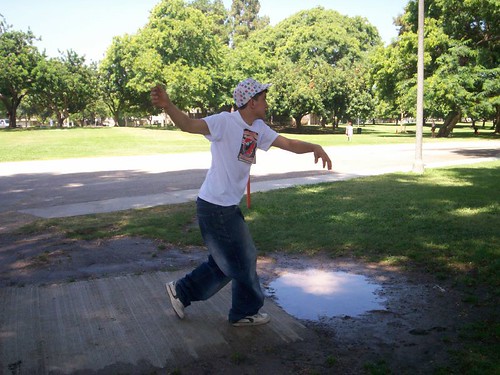
Man, if there is any one super-cheap thing I enjoy doing, it's frisbee-golf. I know I sound like a hippee, but it's true. My buddy Jimmy and I tend to get out once a week to the chains and play 9 or 18 holes, depending on time, but I find myself more and more walking through the muddy lawns of parks in Southern California, disc bag against my back, driver in hand. When my younger brother was out here, we went 3 times I think, over a 2 week period and he was really a suprising shot. His long-game sucked -- he hit every tree and obstacle possible, but his short-game was pretty amazing. Now, I think he is going to build a course in the backwoods, country house my dad has in West Virginia. He went home with one of my discs. The above picture is of him on the 10th hole at El Dorado Park in the LBC.
---------------- ---------------- ---------------- ----------------
On an unrealted topic, I got in the spa for the first time since moving and man, was that shit awesome! Also, went dancing with my sister and some of her friends and I couldn't believe the amount of overly large, unattractive women dancing. ew. Anyway, now I am a little sore, unrested and bored at work. Looking forward to the weekend and some intentional writing.
9.22.2006
Does God Want You Rich?
So, I am at work and I ran across this article on NBC MarketWatch. I have mixed emotions, especially as my church has a tendency toward the prosperity gospel, but makes it so that you have money to give money. Anyway, I don't have too much time to blog today, so read the article for yourself and let me know what you think.
Here's the link . . .
http://biz.yahoo.com/weekend/godmoney_1.html
Here's the link . . .
http://biz.yahoo.com/weekend/godmoney_1.html
9.21.2006
The Subject of Faith

Today I picked up New Seeds of Contemplation again and read a chapter simply entitled "Faith." Merton, in his basic yet poetic prose, steers clear of the purely philosophical or even theological conversations. These words rang as a chord in me and I thought you should hear them...
"The beginning of contemplation is faith. If there is something essentially sick about your faith you will never be a contemplative . . . [Faith] is not a conviction based on rational analysis. You can only believe what you do not know. As soon as you know it, you no longer believe it, at least not in the same way as you know it. Faith is first of all an intellectual assent. It perfects the mind, it does not destroy it. It puts the intellect in possession of Truth which reason cannot grasp by itself. It gives certitude concerning God as He is in Himself; faith is the way to a vital contact with a God Who is alive, and not to the view of an abstract First Principle worked out by syllogisms from the evidence of created things . . . The statements which demand the assent of faith are simply neutral to reason. We have no natural evidence why they should be true or why they should be false. We assent to them because of something other than intrinsic evidence . . . The importance of formulas [theological beliefs] is not that they are ends in themselves, but that they are means through which God communicates His truth to us. They must be kept clear. They must be clear windows, so that they may not obscure and hinder the light that comes to us. They must not falsify God's truth. Therefore, we must make every effort to believe the right formulas. But we must not be so obsessed with verbal corretness that we never go beyond the words to the ineffable reality which they attempt to convey . . . But above all, faith is the opening of an inward eye, the eye of the heart, to be filled with the presence of the Divine Light. Ultimately, faith is the only key to the universe. The final meaning of human existence, and the answers to questions on which all our happiness depends cannot be reached in any other way."
I dont think I have anything else to say, as all of it would seem watered-down after that lengthy quote. Any and all comments welcome, of course.
9.19.2006
It's About That Time of Year Again... and I Feel the Need to Procrastinate
So, we are mid-way through September and the applications for next year's Master's programs have all come out. I should be pretty excited, seeing as how I miss going to class, researching literature and its criticisms, writing papers, all of it. But in reality, I'm really not. I haven't looked at the applications this year to the schools I am applying to (USC, UCLA -- both Comp. Lit., Cal State Long Beach and Fullerton -- both English and probably University of Hawai`i -- Hawaiian Studies) because of the fact that I didn't get into the schools I applied to last year.
I think I have been silently bummed out about not getting in since I received the fateful rejection letters last year, but I understand that I slacked off -- didn't write my writing sample until way late and didn't study for the GRE AT ALL -- and it was really my fault. That, in turn, makes me a lazy ass now, since I sort of question my own talent and intelligence. A real pussy, I know.
The writing sample for the Hawaiian Studies program is going to be on Hawaiian Myth and its similarities, I think, with Greek Myth. Maybe its too blase. I'm still working out the bugs on this one...
I am going to write the sample piece on Hemingway and Garcia-Marquez in relation to post-war literature, emphasizing cultural differences in how to deal with conflict. Since both writers have dealt with war in Latin America, it gives me a contact point from which to spring; Hemingway writes as a foreigner, Marquez as a National. How do these differ? It really isn't that elementary, but you get the point. I'd be using For Whom the Bell Tolls by Hemingway, and The General in His Labyrinth, by Marquez. I also thought about using Across the River and Into the Trees, also by Hemingway, since its a little less known and is also in a flashbacky past-tense, similar to Labyrinth. Please let me know what you guys think, especially if this idea is stupid and I am way off of my rocker.
I think I have been silently bummed out about not getting in since I received the fateful rejection letters last year, but I understand that I slacked off -- didn't write my writing sample until way late and didn't study for the GRE AT ALL -- and it was really my fault. That, in turn, makes me a lazy ass now, since I sort of question my own talent and intelligence. A real pussy, I know.
The writing sample for the Hawaiian Studies program is going to be on Hawaiian Myth and its similarities, I think, with Greek Myth. Maybe its too blase. I'm still working out the bugs on this one...
I am going to write the sample piece on Hemingway and Garcia-Marquez in relation to post-war literature, emphasizing cultural differences in how to deal with conflict. Since both writers have dealt with war in Latin America, it gives me a contact point from which to spring; Hemingway writes as a foreigner, Marquez as a National. How do these differ? It really isn't that elementary, but you get the point. I'd be using For Whom the Bell Tolls by Hemingway, and The General in His Labyrinth, by Marquez. I also thought about using Across the River and Into the Trees, also by Hemingway, since its a little less known and is also in a flashbacky past-tense, similar to Labyrinth. Please let me know what you guys think, especially if this idea is stupid and I am way off of my rocker.
9.14.2006
A little writing with a lot of heart
Here are a few poems I have been toying with lately.
For Orr
In the compost heap that is my life
I can see the orange books
Vivid in the dirty darkness
Making sense of the Void --
Blue lined, word filled pages
Cauterize the chaos
Around me.
Stacked 30 deep
They glare with blackened gold
Letters embossed upon their breasts
Sitting near the typewriter
I am crowned atop the carnage
I am reclining atop the prose.
Seasons
Autumnal leaves arrive ere the season
Summer winds have turned coldest, like black death.
But cometh on Fall weather, come treason
Amidst falling leaves, around me hard pressed.
To grasses green, to the skies brightest blue
Autumn golds and reds here soon to follow
Turn from lively colors to death’s dark hue
Soon comes the Winter bird, gone the swallow.
But with white masks of winter’s ‘ternal sleep
Come slush from snowings, and most icy rain
Within three months hear the new robin’s peep
And thaw the rivers, snows begin to drain.
Though Autumn leaves lead to snow and rain
Prepare the way for Spring to come again.
Desert Wonder
Spherical expanse of sky
Gone cobalt, liquefied
Dark sapphire inlaid
With glimmering diamonds—
Twilight
Flashes momentary
Over dark mountains
Silhouettes
Gray-white fluffs
A barrier of protection
Thin and strong
Against the storm.
Airplane lights
Down below—
Reflected in the skies
Off dark waters.
For Orr
In the compost heap that is my life
I can see the orange books
Vivid in the dirty darkness
Making sense of the Void --
Blue lined, word filled pages
Cauterize the chaos
Around me.
Stacked 30 deep
They glare with blackened gold
Letters embossed upon their breasts
Sitting near the typewriter
I am crowned atop the carnage
I am reclining atop the prose.
Seasons
Autumnal leaves arrive ere the season
Summer winds have turned coldest, like black death.
But cometh on Fall weather, come treason
Amidst falling leaves, around me hard pressed.
To grasses green, to the skies brightest blue
Autumn golds and reds here soon to follow
Turn from lively colors to death’s dark hue
Soon comes the Winter bird, gone the swallow.
But with white masks of winter’s ‘ternal sleep
Come slush from snowings, and most icy rain
Within three months hear the new robin’s peep
And thaw the rivers, snows begin to drain.
Though Autumn leaves lead to snow and rain
Prepare the way for Spring to come again.
Desert Wonder
Spherical expanse of sky
Gone cobalt, liquefied
Dark sapphire inlaid
With glimmering diamonds—
Twilight
Flashes momentary
Over dark mountains
Silhouettes
Gray-white fluffs
A barrier of protection
Thin and strong
Against the storm.
Airplane lights
Down below—
Reflected in the skies
Off dark waters.
The trip we made to the Santa Monicas...
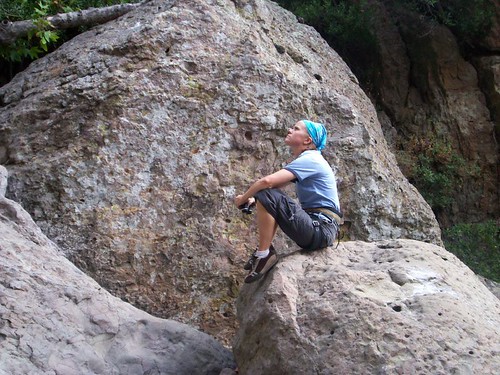
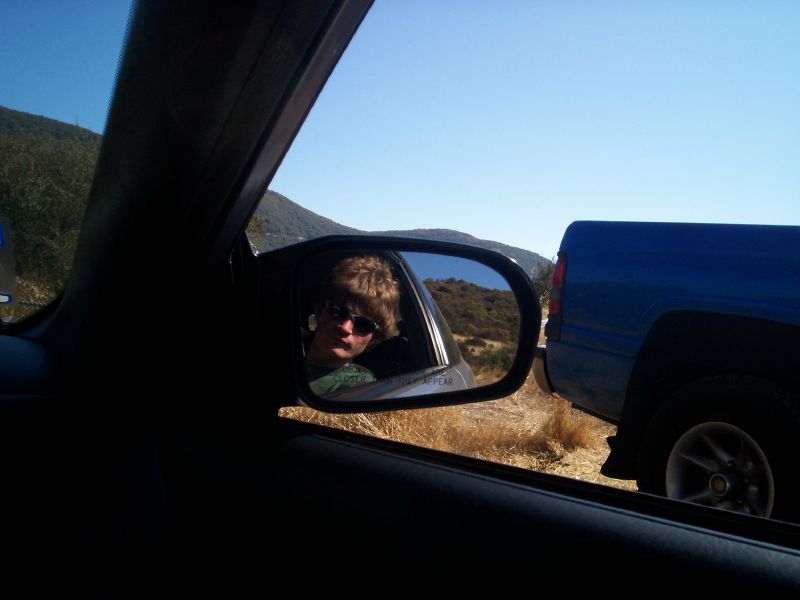
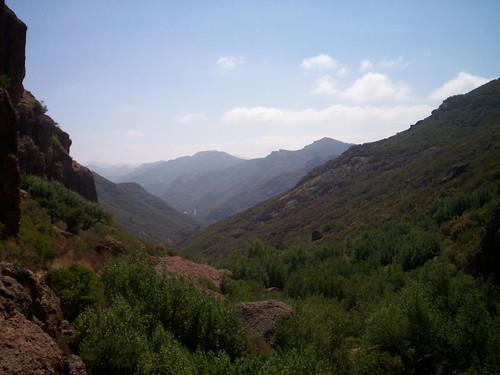
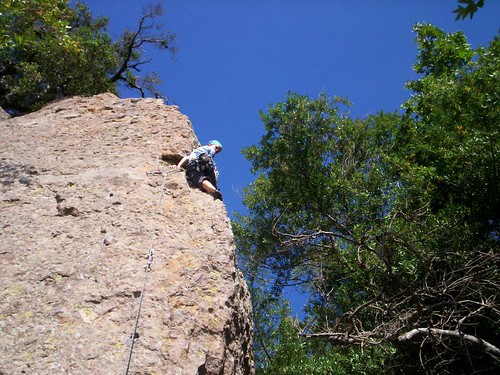
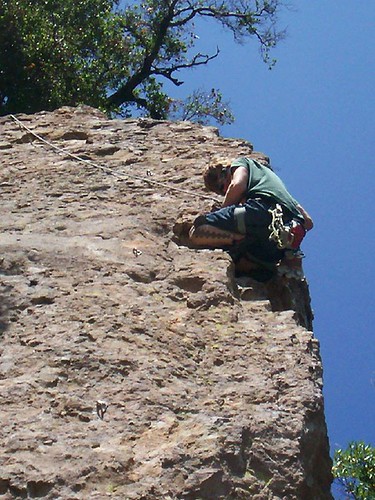
For those of you who dont know, I love to rock climb. I picked it up after working at a summer camp on and off during my college career and I cant seem to get enough of it now. I've always been a bit of a monkey, climbing trees, lightposts, telephone poles and what have you since I can remember. But in climbing the rocky face of a wall, crack or slab so that my fingers pinch and sweat -- my chalk-stained hands slipping from the contoured surface until they find some niche to hold my weight-- I feel a sense of freedom and fear that I cannot experience anywhere else. Climbing teaches me about myself and stretches me beyond what I would ordinarily experience.
That said, my climbing buddy April and I decided to climb at an area in the Santa Monica mountains known as Echo Cliffs. Pre-dawn, we packed our gear into her Honda Civic, stopped for snacks and water, and were well on our way from Fullerton to Thousand Oaks. It was a Saturday morning and we drove with the sun rising at our backs, saluting our trip. We hit traffic on the 101, growing weary of the concrete and skyscrapers, desperately hoping to be rid of the city-scape. An hour and a half later, we pulled off the freeway at Westlake Road, made a left, and headed into the hills.
The Santa Monicas are located between the beach at Santa Monica (where the 10 meets Pacific Coast Highway) all the way up to Thousand Oaks and contains some of the best climbing in Southern California. The rock is a volcanic conglomerate called brecchia and doesn't trash your hands. The especially nice perks though, are three-fold: 1. The climbing area is large enough that we don't run into a lot of people, 2. There is shade all-day and we don't get run out by the scorching sun and, 3. There is a multitude of water holes close by, should you feel the need to swim.
The approach is about 2.1 miles over a well-worn path, so that you climb upward half of the time, then dip into the valley and skirt its farthest border, where the feet of the hills meet the wide ravine-like stretch. A mile and a half into the hike, we made a right and scrambled down a gully filled with boulders and tipsy choc-stones. Navigating the bends in the road, we came to the valley floor and were happy at the shade and sound of running water.
We couldn't have asked for a better area. Sycamore trees abound in the grotto -- the area we were climbing -- and provide enough shade and root-work to have a place to set our gear, find a comfortable position and take a nap if need be. We immediately worked out a route, April leading it and I belaying her. The bolts shone in the din of the sunlight, her quickdraws slipping over an end, and the rope following quickly. After about an hour and a half, some cursing, a cramped neck and a lot of work, she made it to the top of Gameboy, the 5.8 that climbed like a 5.10. She celebrated above me while I removed my camera from its pouch, snapped off a few shots and knocked back a gulp from my Nalgene bottle. We did this back and forth throughout the day, taking turns. After climbing a bit at the head of the grotto, we moved into the nook under the trees to avoid the sunlight that nearly burned our necks. The climbing there, too, couldn't have been better.
By the time we left, we had each ticked off three new climbs and were none the worse for wear. The drive home was nice -- I took a nap after sticking my head out the window at 70 mph -- and the sunlight found its way to our backs, quietly and alone.
Subscribe to:
Posts (Atom)
